Read more:
https://majedaltir.com/b2g-marketing-saudi-arabia-how-foreign-companies-win-government-contracts-in-a-multi-market-kingdom/
B2G Marketing Saudi Arabia: How Foreign Companies Win Government Contracts in a Multi-Market Kingdom
B2G Marketing Saudi Arabia: How Foreign Companies Win Government Contracts in a Multi-Market Kingdom
Saudi Arabia’s public sector is the primary buyer in the economy. With annual government procurement exceeding SAR 400 billion and foreign direct investment reaching SAR 22.8 billion in Q2 2025, the kingdom is not short on business opportunities. But foreign companies entering this market with a single thesis, one pitch, one campaign, or one cultural framework lose before they begin. B2G marketing in Saudi Arabia requires strict alignment with Vision 2030 objectives, institutional trust-building, and a willingness to operate across several overlapping markets simultaneously. This article is written from my perspective as a senior Saudi-based advisor who has led national programs and campaigns across banking, culture, tourism, sports, and technology. What follows is field-grounded, not theoretical.
Understanding the Saudi B2G Landscape: Several Markets, Not One
Treating Saudi Arabia as a single government market is the first structural error. The kingdom contains several distinct institutional environments, each with different procurement logic, decision-makers, and expectations.
Core institutional segments include:
- Central government – Council of Ministers, key ministries (Finance, Health, Investment), and agencies governed by the Government Tenders and Procurement Law (GTPL), using the Etimad platform for vendor registration and bid submission.
- Sovereign funds and PIF portfolio – the Public Investment Fund and its subsidiaries operate with quasi-independent budgets and hybrid governance.
- Giga-projects and royal commissions – NEOM, Red Sea Global, Diriyah, and Qiddiya each function as their own B2G market with separate procurement teams and supplier portals.
- Sector regulators – entities like GAMI (military industries), which has processed 289 procurement requests totaling SAR 82 billion, with strict localization mandates.
Vision 2030 is the organizing framework. Programs for tourism, culture, sports, digital infrastructure, healthcare, energy transition, and logistics directly shape RFPs and government contracts. Public institutions significantly influence every sector linked to these priorities. Saudi Vision 2030 encourages the use of local suppliers and technology transfer, and government entities are increasingly focusing on digital transformation and automation. The Saudi government is also focused on increasing transparency in procurement processes – a shift from older, relationship-only models. The scale of investment, the pace of structural change since 2016, and the degree of centralization of major decisions in Riyadh distinguish this from any Western public sector equivalent.
Key Differences Between B2G and B2C/B2B in the Saudi Market
B2G in the saudi market is structurally different from classic B2B. Decisions are political, strategic, and reputational – not only commercial. The key differences run deep:
| Dimension | B2C / B2B |
B2G Saudi Arabia |
|---|---|---|
| Value drivers | Price, features, speed | Vision 2030 alignment, Saudization, knowledge transfer |
| Sales cycle | Weeks to months | 9–24 months for sizable deals |
| Decision logic | Commercial ROI | National capability-building, reputational impact |
| Compliance burden | Standard regulations | GTPL, PDPL, sector-specific rules, local content mandates |
| Relationship capital | Brand awareness | Institutional access, senior stakeholder credibility |
Decision-making in Saudi Arabia is highly centralized and bureaucratic. Companies must align with Vision 2030 to succeed. Government procurement prioritizes measurable impact and risk management over lowest price. Vendors must demonstrate compliance with local labor and tax regulations. Up to 80% Saudization is required in healthcare and professional services, and some retail sectors require up to 70% Saudi employment by 2026. Saudi Arabia’s real GDP expanded by 5% in 2025, driving demand across sectors – but that demand flows through governance structures, not open markets.
How Geography Shapes B2G Marketing: Riyadh, Jeddah, Dammam, and the New Destinations
Foreign companies often assume one unified buying center. The reality is city- and cluster-specific.
Riyadh is the political and financial capital. The strategic focus here is government relations, regulatory compliance, and senior institutional engagement. Strategic government contracts and policy-driven programs are anchored here. If your organization lacks senior presence in Riyadh, you are invisible to the institutions that matter.
Jeddah serves as the commercial and cultural gateway – more relevant for municipalities, ports, Hajj and Umrah infrastructure, and tourism projects where B2G blends into public-facing campaigns. The focus here is brand visibility, public-facing marketing, and consumer engagement around tourism and municipality-linked projects.
Dammam and the Eastern Province carry industrial weight. Energy, logistics, and long-term infrastructure contracts with entities like Saudi Aramco, SABIC, and industrial cities authorities define this region. The focus here is industrial procurement and supply chain efficiency alongside technical, safety, and environmental standards.
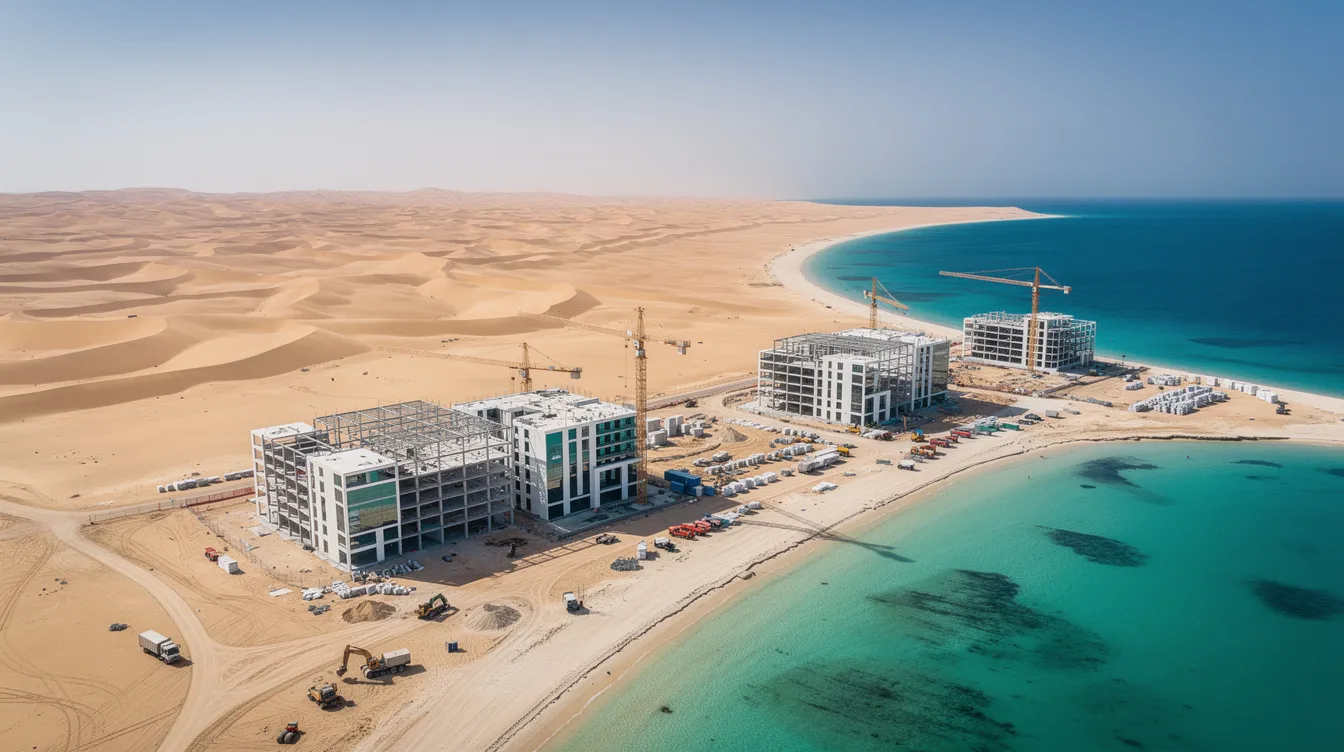
The new destinations – NEOM, Red Sea Global, Diriyah, Qiddiya – each run sophisticated procurement processes. They expect partners to understand their distinct brand position, sustainability standards, and visitor experience models. Their strategic location within the kingdom’s future economy makes them essential targets, but each demands a tailored approach for companies that want to expand city by city rather than treat Saudi Arabia as one uniform market.
Designing a Saudi B2G Market Entry Strategy for Foreign Companies
Most foreign entities fail in Saudi B2G by translating existing strategies instead of redesigning them. Market entry typically spans 9–12 months in five phases, and each phase requires dedicated resources.
Legal and operating model – choosing between a local entity, joint venture, RHQ, or project office is a B2G decision, not only a tax decision; these choices affect how a company can establish its presence in Riyadh and compete for public-sector work. Since January 2024, foreign companies must hold a valid RHQ license to bid for government contracts above SAR 1 million. This route can offer benefits for companies making a long-term commitment. MISA registration typically takes 2–6 weeks for processing.
Segment clarity – before designing value propositions, determine whether you are targeting central ministries, sector regulators, giga-projects, municipalities, or state-owned enterprises. Each requires different narratives and positioning.
Presence and staffing – senior in-country leadership is non-negotiable. Arabic-speaking Government Relations Officers, local teams embedded in Riyadh, and the ability to engage regularly in institutional dialogues are prerequisites, not luxuries.
Sequencing matters:
- Market intelligence and ecosystem mapping
- Legal entity establishment and Etimad registration – almost all government tenders are centralized on the Etimad platform
- Initial institutional dialogues and pilot engagements
- Scaled pursuit of framework agreements and government contracts
Building Trust, Relationships, and Institutional Access
In Saudi B2G, the invisible market of relationships is often more decisive than any formal tender announcement. Building trust with government agencies requires localized marketing efforts – not imported credibility.
Formal access includes registered vendor status, framework agreements, and RHQ licensing. Informal access operates through trusted introductions, Majlis culture, and reference networks. Both are essential. Neither alone is sufficient.
Credibility signals matter: the quality of Arabic and English materials, the seniority of people sent to meetings, and continuity of customer engagement – not fly-in/fly-out visits. Government agencies prefer suppliers with a strong track record and proven capabilities. Public sector marketing in Saudi Arabia is a trust-based process that requires localized content.
Participating in government-sponsored trade shows is important for building relationships. Attendance at major exhibitions and conferences is crucial for networking with Saudi officials. Using local advisors – law firms, strategy advisors, sector specialists – provides direct access to understanding how decisions actually travel inside ministries and authorities.
B2G marketing content must be tailored for decision committees and technical reviewers: white papers, pilot results, benchmarks, and clear risk-mitigation narratives. Not just leadership presentations.
Crafting a B2G Value Proposition Aligned with Vision 2030
Successful B2G marketing always makes explicit how a solution advances measurable Vision 2030 targets. Vision 2030 aims to diversify Saudi Arabia’s economy beyond oil – every proposal must speak to that ambition.
Translate corporate offerings into national outcomes: jobs for Saudis, knowledge transfer, local capability-building, ESG impact, and regional competitiveness. Saudi Arabia emphasizes local content and economic development in B2G strategies. B2G proposals are evaluated on sustainable practices and responsible operations.
Marketing materials should highlight past performance and localized case studies. And the data supports why: 95% of affluent Saudis value supporting local enterprises, which means proposals that demonstrate investment in the local economy carry genuine weight.
Messaging must be layered:
- Leadership narrative – Vision 2030 impact, growth contribution, economic diversification
- Technical narrative – standards, interoperability, security, compliance
- Finance/procurement narrative – total cost of ownership, risk mitigation, governance
Show long-term commitment: investment in local teams, training programs, R&D centers, partnerships with Saudi universities, and digital upskilling initiatives. Whether in healthcare, logistics, or digital government platforms, the value proposition must demonstrate that you plan to invest in the kingdom, not extract from it.
Localization Beyond Translation: Communicating Effectively with Saudi Institutions
Translating pitch decks into Arabic is not localization. Saudi decision-makers recognize generic adaptation immediately. Localization is essential for marketing strategies in Saudi Arabia – and it goes far beyond language.
Saudi Gen Z prefers brands that understand local culture. Saudi Gen Zers increasingly value authenticity in advertising campaigns, and 96% of Saudi internet users aged 16-24 watch video-on-demand. Cultural context significantly influences consumer behavior in Saudi Arabia, even within institutional procurement – because evaluators are people shaped by the same cultural expectations. Content must feel specifically “made for Saudi” to resonate. The young population driving this country’s future has no patience for imported messaging with a local veneer.
Build Saudi-relevant proof points: pilots with a local authority, data from a Gulf neighbor facing similar conditions, alignment with Saudi regulatory frameworks. Use examples such as a pilot with a Saudi authority or a case adapted to local regulatory and cultural expectations. Reference applicable laws and circulars explicitly. Concise executive summaries in Arabic, clear risk and compliance sections, and cultural relevance in every visual and case study – these are not optional. They are the baseline. And remember: 95% of affluent Saudis support local enterprises and crafts, reinforcing that national identity runs through every layer of evaluation.

From Marketing to Contracts: Navigating the Saudi Procurement Journey
Procurement is the bridge between B2G marketing and actual government contracts. The typical journey spans 12–18 months from first meeting to first contract:
- Relationship-building and ecosystem mapping – supported by thought leadership and institutional presence
- Qualification and pre-approval – vendor registration, RHQ status, financial statements and compliance documentation
- RFP/RFQ participation – two-envelope systems (technical then financial evaluation), often with local content weighting
- Negotiations and contract execution – scope adjustments, Saudization commitments, performance guarantees
- Long-term framework agreements – repeat engagement based on delivery excellence
Centralization of decision-making affects tender timing and scope changes. Internal readiness is essential: legal, finance, compliance, and delivery teams must be aligned before bidding. Success depends on having every function prepared – not just the commercial businesses development team. Localization is essential for effective marketing at every phase, from initial contact through contract renewal.
Common B2G Market Entry Mistakes in Saudi Arabia
Most foreign companies lose 12–24 months due to avoidable errors:
- Treating Saudi Arabia as an extension of UAE operations – different laws, different governance, different business culture, different expectations
- Lacking senior on-ground presence – relying on a single intermediary without institutional credibility or expertise
- Using generic global messaging – copy-paste positioning that ignores Saudization, capability-building, and sector-specific needs
- Confusing public-sector timelines with private-sector urgency – over-promising speed destroys credibility
- Using Western youth or generic “Arab” imagery – instead of Saudi-specific references and national identity markers
- Ignoring regulatory requirements – missing RHQ obligations, local content mandates, or sector regulations
Failing early with a key ministry or authority can quietly close doors across the network. Reputation in this market is interconnected. Recovery is expensive and slow.
How Majed Altir Supports B2G Marketing and Market Entry in Saudi Arabia
I operate as a Riyadh-based senior advisor who has operationalized Vision 2030 objectives into real national programs, campaigns, and institutional brands across the Middle East. My engagements with foreign companies and regional organizations typically take three forms: strategic advisory retainers, fractional or interim marketing and communications leadership, and project-based support for B2G go-to-market and major tenders.
For investors and leaders at companies evaluating expansion into Saudi government contracting, I bring specific capabilities: market positioning and competitive strategy, stakeholder and government engagement plans, narrative and proposal development for a global audience of decision-makers, and national campaign leadership. My cross-sector experience – spanning financial institutions, culture, tourism, sports, media, and technology – means I apply patterns from one sector to solve problems in another. That cross-sector thinking is a crucial role differentiator when the future of Saudi procurement demands solutions, not templates.
If you are planning Saudi B2G market entry, the right starting point is a strategic conversation – not a transactional RFP response. I welcome that conversation with executives who are serious about building institutional presence in the kingdom, not just visiting it.ٍ
About the author
Majed Altir is a strategic marketing and communications leader with over fifteen years of experience across Saudi Arabia and the GCC. His work spans banking, media, technology, government, destination marketing, culture, entertainment, and sports, leading complex, large-scale campaigns and initiatives that have reached consumers, investors, industry leaders, organizations, and decision-makers across global markets. A recipient of 8 communication and campaign awards earned across multiple teams and sectors, he writes the Cross-Sector Thinking series, perspectives on marketing, communications, strategy, branding, and change for leaders who would rather shape markets than follow them.
← Back to Writing