Read more:
https://majedaltir.com/industry/breaking-down-the-shared-byline-how-linkedins-collaborative-posts-redefine-b2b-growth-and-professional-trust/
How LinkedIn’s Collaborative Posts Redefine B2B Growth and Professional Trust
How LinkedIn’s Collaborative Posts Redefine B2B Growth and Professional Trust
Breaking Down the Shared Byline
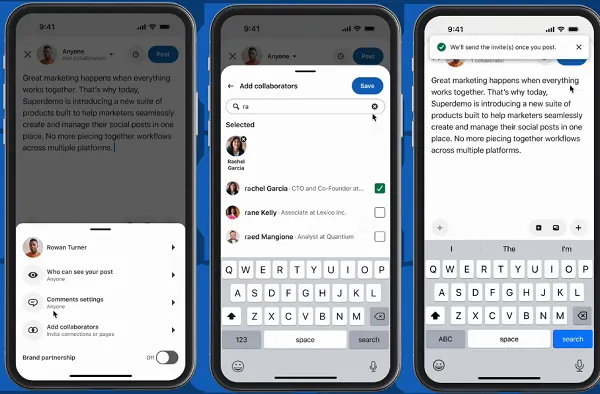
LinkedIn is transforming co-authorship from simple text tags into a visible, algorithmic signal. With the rollout of “Collaborative Posts” (Collab Posts), the platform allows two or more accounts—whether personal profiles or company Pages—to co-author a single native post.
Unlike traditional tagging that simply hooks a username into a caption, a Collaborative Post places every author’s name and avatar clearly at the very top of the header. Once an invitation is accepted, the post lands natively across the networks of all collaborators simultaneously.
This update represents a structural change in how professional authority is built and distributed. For professionals operating at the intersection of Business Development, B2B Marketing, and Digital Strategy, this feature provides direct strategic utility.
1. For Business Development (BD) Experts: Accelerating Social Selling and Partnership Velocity
In Business Development, trust is the primary currency. Traditionally, introducing a strategic partnership or a new client milestone involved a detached announcement on a company page, or one-sided tagging that easily got lost in the feed.
-
Visible Accountability: Collab Posts move the relationship into the post’s core identity layer. When a BD lead co-authors a post with a key client, vendor, or merger partner, it serves as a public badge of shared endorsement.
-
Expanding the Prospecting Funnel: BD professionals can use this tool to co-market joint ventures or ecosystem launches. By natively pushing the announcement to both parties’ connection lists simultaneously, it bridges the gap between warm networks, dramatically reducing the friction of cold prospecting and accelerating pipeline velocity.
2. For B2B Marketers: Solving the “Company Page Engagement” Dilemma
B2B marketers have long struggled with a persistent issue: corporate pages suffer from lower organic reach compared to personal accounts. People want to engage with other people, not faceless corporate logos.
-
Borrowing Human Credibility: Collab Posts allow brands to combine the operational reach of a company page with the human, high-converting pull of individual experts.
-
Seamless Creator & Influencer Campaigns: Instead of relying on a paid mention in a post caption, a B2B brand can co-author a single asset alongside an industry influencer, a subject-matter expert, or a product manager. This translates to higher organic reach, authentic audience cross-pollination, and cleaner campaign tracking.
3. For Digital Strategists: Engineering Algorithm-Compliant, Omnichannel Campaigns
LinkedIn’s updated algorithm rewards original insights, domain expertise, and deep discussion over engagement bait. Digital strategists can capitalize on this feature to build sustainable, high-performing content ecosystems.
-
Maximizing Organic Reach Without Ad Spend: Because a singular piece of content distributes to multiple professional circles instantly, it signals immediate algorithmic value, multiplying initial dwell time and cross-network engagement.
-
Structuring Shared Value: A digital strategist can design co-marketing campaigns where two distinct entities—such as an agency and a SaaS provider—team up to launch an industry report or a webinar. The shared byline frames the digital asset as an authoritative, cross-industry initiative rather than a standard sales pitch.
Tactical Action Plan: How to Prepare Your Workspace
Since this feature relies on an “invite-and-accept” flow, professionals should optimize their operational setup immediately to capitalize on the feature as its rollout broadens:
-
Optimize Your Professional Front Door: A Collab Post drives a massive influx of new, highly relevant eyes to your profile. Ensure your headline, featured section, and digital branding clearly communicate your core value proposition.
-
Audit Corporate Governance (For Admins): If you manage a B2B Company Page, a Super Admin must access the account settings (Me → Settings → Notifications → Collaborations) to explicitly allow incoming collaboration invites.
-
Map Out a Co-Authorship Matrix: Begin drafting a shortlist of trusted partners, executive champions, and key clients who would make strong co-authors for future product launches, case studies, or event recaps.
← Back to Industry News